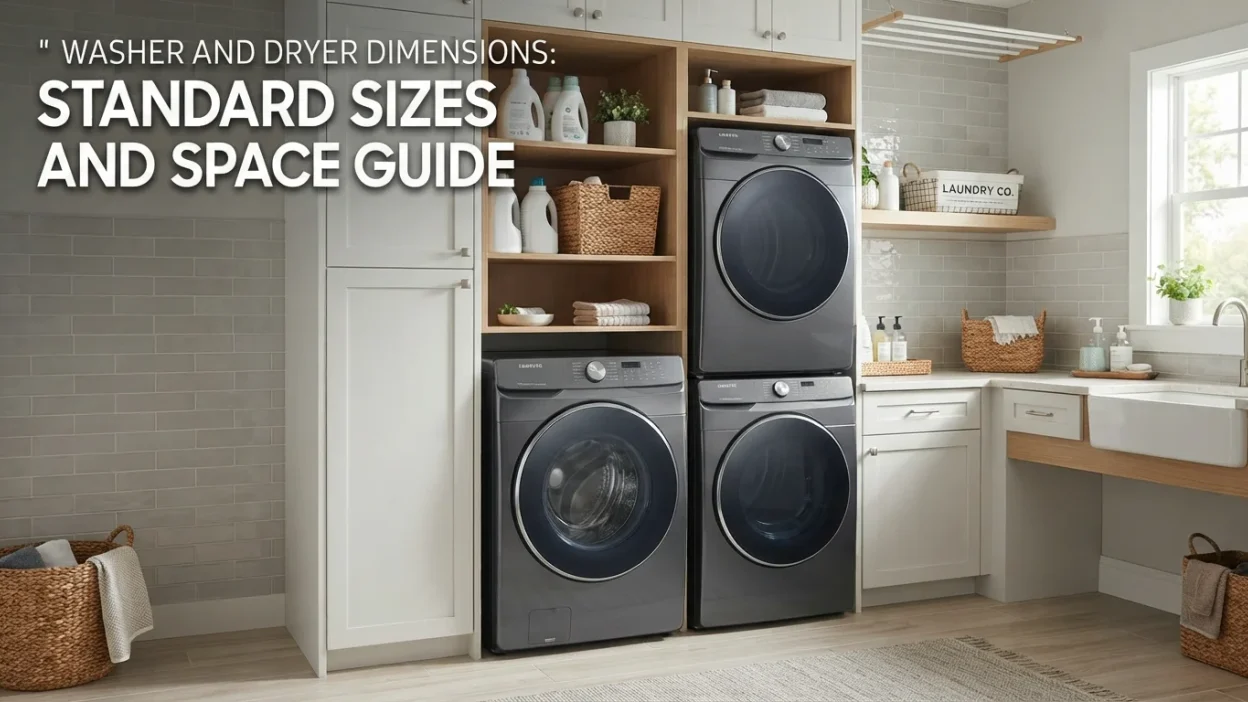
Choosing the right laundry appliances involves more than comparing features, energy efficiency, and washing capacity. You also need to understand washer and dryer dimensions to make sure the machines fit your laundry room, closet, or utility area. Even a small difference in depth or height can create installation problems when space is limited.
Most full-size residential washers and dryers are approximately 27 inches wide, although their height and depth vary by model. Compact appliances are often around 24 inches wide, while stacked laundry pairs require additional vertical clearance. Understanding these measurements before purchasing can help you avoid delivery difficulties and make better use of your available space.
In this guide, you will discover standard washer and dryer sizes, measurements for different appliance types, laundry closet dimensions, clearance requirements, and practical tips for measuring your space.
Standard Washer and Dryer Dimensions
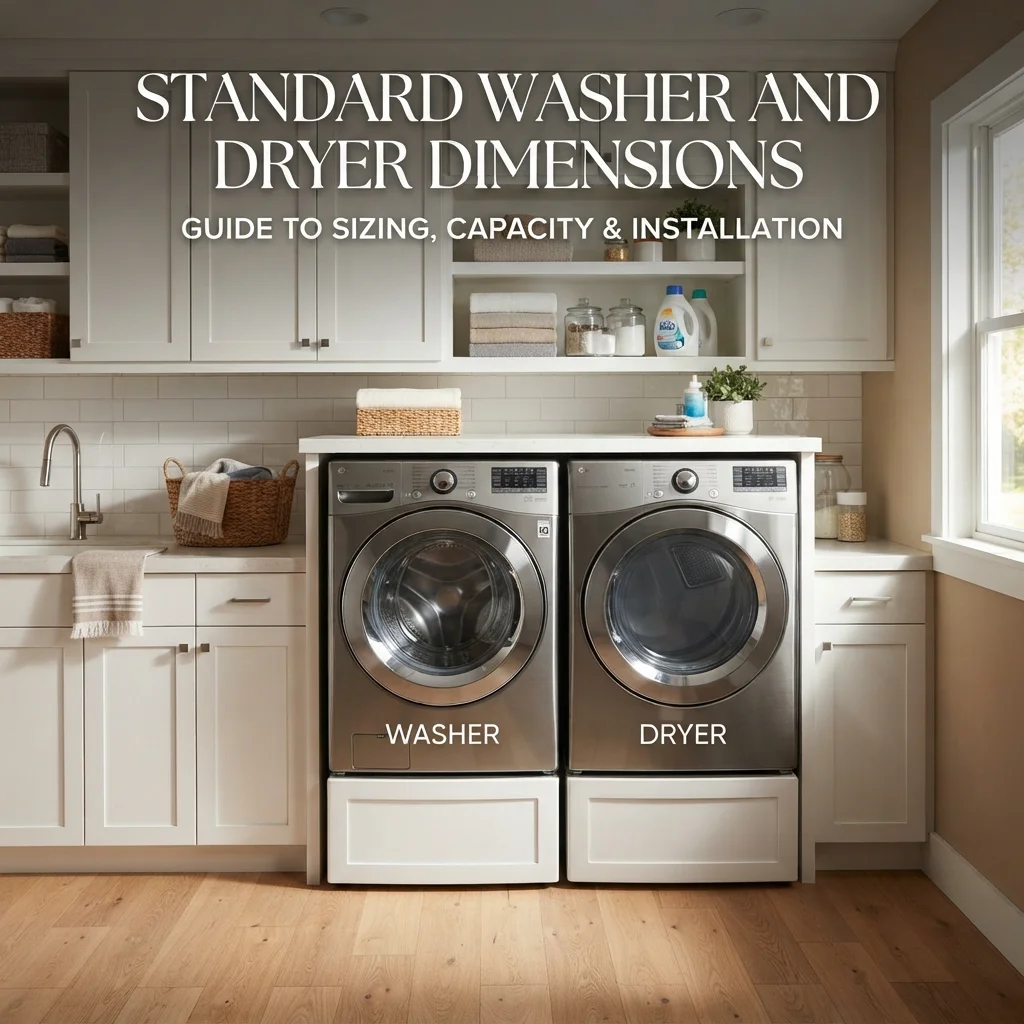
Standard washer and dryer dimensions vary according to the manufacturer, appliance design, and load capacity. However, many full-size residential machines share similar exterior measurements.
The following table provides approximate dimensions for common household laundry appliances.
| Appliance Type | Width | Height | Depth |
|---|---|---|---|
| Standard washer | 27 inches | 38–40 inches | 30–34 inches |
| Standard dryer | 27 inches | 38–40 inches | 30–34 inches |
| Top-load washer | 27–28 inches | 42–44 inches | 27–29 inches |
| Compact washer | 24 inches | 33–35 inches | 24–26 inches |
| Compact dryer | 24 inches | 33–35 inches | 24–27 inches |
| Stacked laundry pair | 24–27 inches | 66–80 inches combined | 27–34 inches |
These figures are general planning estimates rather than specifications for every model. Some large-capacity machines may be wider, taller, or deeper than the ranges shown.
How Much Space Does a Standard Washer and Dryer Need?
When installing a washer and dryer side by side, two 27-inch-wide machines occupy approximately 54 inches of combined width. However, the total installation area must also accommodate connections, ventilation, and any manufacturer-required gaps.
A practical starting point for planning a side-by-side laundry area is:
- Width: Approximately 60 inches or more.
- Height: At least 40–42 inches for the appliances, with additional room for cabinets or other overhead obstructions.
- Depth: Approximately 36–40 inches, depending on the machines and their connections.
These dimensions are not universal minimums. Always compare your available space with the installation instructions for your selected appliances.
Front-Load Washer Dimensions
Front-load washers have a door on the front panel, allowing you to load and remove laundry without lifting a lid. Many models can also support a compatible dryer installed above them using an approved stacking kit.
Most full-size front-load washers have the following approximate measurements:
| Measurement | Typical Size |
|---|---|
| Width | 27 inches |
| Height | 38–40 inches |
| Depth | 30–34 inches |
| Capacity | Approximately 4.5–5.5 cubic feet |
Larger-capacity models may require more depth, so check the exact product specifications before choosing a machine.
Front-Load Washer Clearance Requirements
The main consideration with a front-load washer is the space needed to open its door. The door projects forward when opened, so a narrow walkway or nearby cabinet can make loading laundry uncomfortable.
Before installation, consider these factors:
- Leave enough open floor space in front of the appliance.
- Check the door swing direction and hinge position.
- Make sure the door does not hit a wall, cabinet, or closet door.
- Account for the space needed to bend down and remove wet clothing.
- Include any extra depth required for water hoses and drain connections.
If you plan to install the washer in a closet, check both the appliance dimensions and the opening through which the laundry will be loaded.
Top-Load Washer Dimensions
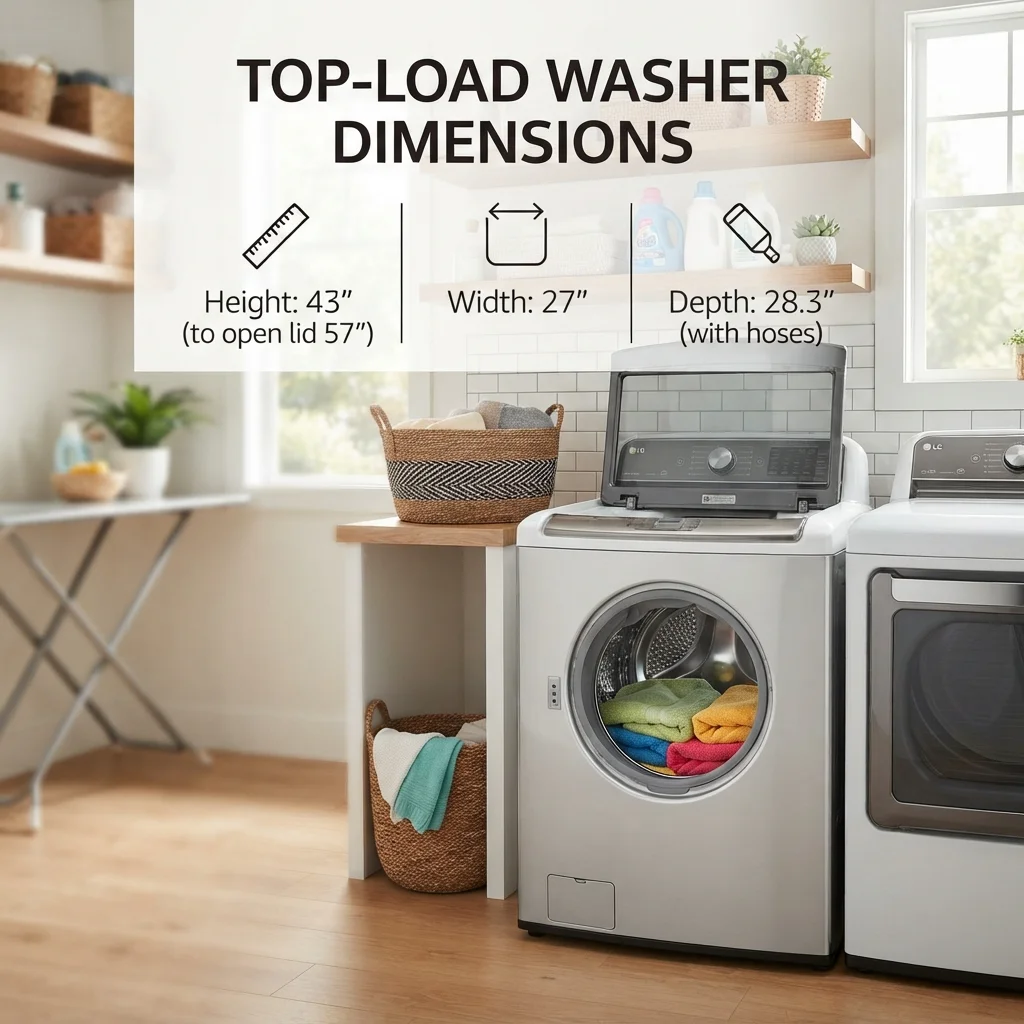
Top-load washers have an opening on the upper surface instead of a front-facing door. They can be convenient for people who prefer loading laundry from above, but their lid requires sufficient overhead clearance.
Typical top-load washer measurements are shown below.
| Measurement | Typical Size |
|---|---|
| Width | 27–28 inches |
| Height | 42–44 inches |
| Depth | 27–29 inches |
| Capacity | Approximately 3.5–5.5 cubic feet |
Actual dimensions depend on the washer model, drum capacity, and lid design.
How Much Clearance Does a Top-Load Washer Need?
A top-load washer needs more vertical space when its lid is open than when it is closed. This makes overhead cabinets, shelves, and countertops important considerations during installation.
For example, a washer that measures 43 inches high when closed may need considerably more vertical clearance for its lid to open fully.
Before buying one, check the manufacturer’s specifications for the open-lid height. Also, avoid placing a dryer above a top-load washer unless the manufacturer specifically approves that configuration. Most traditional top-load washers are not designed for standard stacking arrangements.
Standard Dryer Dimensions
Dryers are often designed to match the width and general height of full-size washers, making side-by-side installation convenient. However, the depth can vary according to capacity and design.
| Measurement | Typical Size |
|---|---|
| Width | Approximately 27 inches |
| Height | 38–40 inches |
| Depth | 30–34 inches |
| Capacity | Approximately 7.0–9.0 cubic feet |
Dryer capacity is generally larger than washer capacity because clothing needs room to tumble during the drying process.
Electric vs. Gas Dryer Dimensions
Electric and gas dryers from the same product family may have similar exterior dimensions. Their primary differences involve the utility connections required for operation.
Electric dryers: Many full-size models require a dedicated 240-volt electrical circuit, although requirements vary by model. Some compact dryers use different electrical connections.
Gas dryers: These appliances require an appropriate gas connection and an electrical supply for their controls and other components.
Vented and ventless dryers: Vented models need an exhaust route, while ventless models use a different moisture-removal system. Both types must have the clearances and airflow specified by the manufacturer.
When measuring for a dryer, account for the rear connections and any exhaust duct. A machine that fits the available floor dimensions may still need additional installation space.
Stackable Washer and Dryer Dimensions
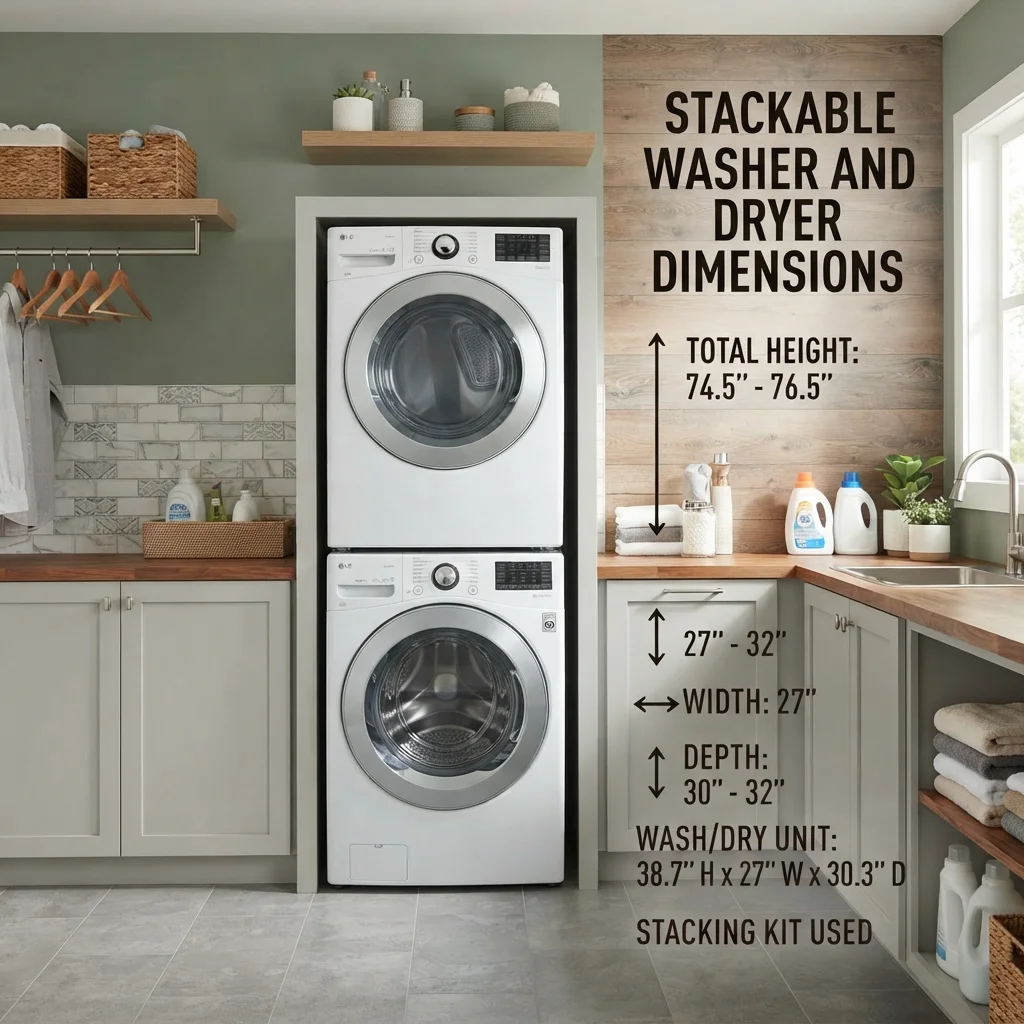
Stackable washer and dryer sets place the dryer above the washer, reducing the amount of floor space needed for laundry appliances. They are useful in apartments, small homes, and laundry closets where side-by-side installation is impractical.
Common stacked washer and dryer dimensions include:
| Measurement | Approximate Size |
|---|---|
| Width | 24–27 inches |
| Combined height | 66–80 inches |
| Depth | 27–34 inches |
Compact stacked pairs are generally narrower than full-size configurations. However, the overall height depends on the individual appliances and the stacking hardware.
How Much Space Do Stacked Appliances Need?
A full-size stacked laundry pair may fit within an area approximately 30 inches wide, but the available space must also accommodate connections, installation clearances, and the height of the complete assembly.
Consider these planning measurements:
- Width: Around 30 inches or more.
- Height: Approximately 84 inches or more, depending on the models and required overhead clearance.
- Depth: Around 36–40 inches, subject to the appliance and connection requirements.
Measure from the floor to the lowest obstruction above the proposed installation area. Remember that the stacking kit may add height.
Only stack appliances that the manufacturer identifies as compatible. Use the approved stacking kit and follow the installation instructions rather than placing one machine directly on another.
Compact Washer and Dryer Dimensions
Compact washers and dryers are designed for homes with limited laundry space. They are often used in apartments, condominiums, small utility rooms, and closets.
Many compact appliances measure approximately 24 inches wide, although dimensions differ among models.
| Measurement | Compact Washer | Compact Dryer |
|---|---|---|
| Width | Around 24 inches | Around 24 inches |
| Height | 33–35 inches | 33–35 inches |
| Depth | 24–26 inches | 24–27 inches |
| Capacity | Approximately 2.0–2.5 cu. ft. | Approximately 4.0–4.5 cu. ft. |
These figures represent typical examples rather than guaranteed measurements. Some compact appliances have different heights, depths, and capacities.
Are Compact Washers and Dryers a Good Choice?
Compact machines can be suitable when a full-size laundry pair will not fit. Their smaller footprint may make them easier to install in tight spaces.
However, a smaller washer may require more loads to handle the same amount of laundry. Consider your household size, washing frequency, and the types of items you regularly clean.
Some compact dryers are ventless, which can simplify installation where an exterior exhaust duct is difficult to install. Nevertheless, ventless appliances still require appropriate clearance, ventilation around the machine, and any specified drainage arrangements.
Washer and Dryer Dimensions in Inches, Feet, and Centimeters
Converting washer and dryer dimensions into different units can make it easier to plan a laundry room, particularly when comparing product specifications or measuring a space.
Remember that 12 inches equal 1 foot, while 1 inch equals 2.54 centimeters.
| Measurement | Inches | Feet | Centimeters |
|---|---|---|---|
| Compact appliance width | 24 inches | 2 feet | 60.96 cm |
| Standard appliance width | 27 inches | 2.25 feet | 68.58 cm |
| Standard appliance height | 40 inches | 3.33 feet | 101.6 cm |
| Standard appliance depth | 32 inches | 2.67 feet | 81.28 cm |
| Two standard machines side by side | 54 inches | 4.5 feet | 137.16 cm |
| Example stacked height | 72 inches | 6 feet | 182.88 cm |
For example, two standard appliances measuring 27 inches wide each require 54 inches of combined width before allowing for installation gaps or surrounding space.
How to Convert Appliance Measurements
Use these simple formulas when converting dimensions:
- Inches to feet: Divide the number of inches by 12.
- Feet to inches: Multiply the number of feet by 12.
- Inches to centimeters: Multiply the number of inches by 2.54.
- Centimeters to inches: Divide the number of centimeters by 2.54.
Suppose a washer measures 33 inches deep. Dividing 33 by 12 gives 2.75 feet, while multiplying 33 by 2.54 gives 83.82 centimeters.
These conversions are useful when planning cabinetry, comparing appliance specifications, or checking whether a machine fits through an available opening.
Washer and Dryer Closet Dimensions
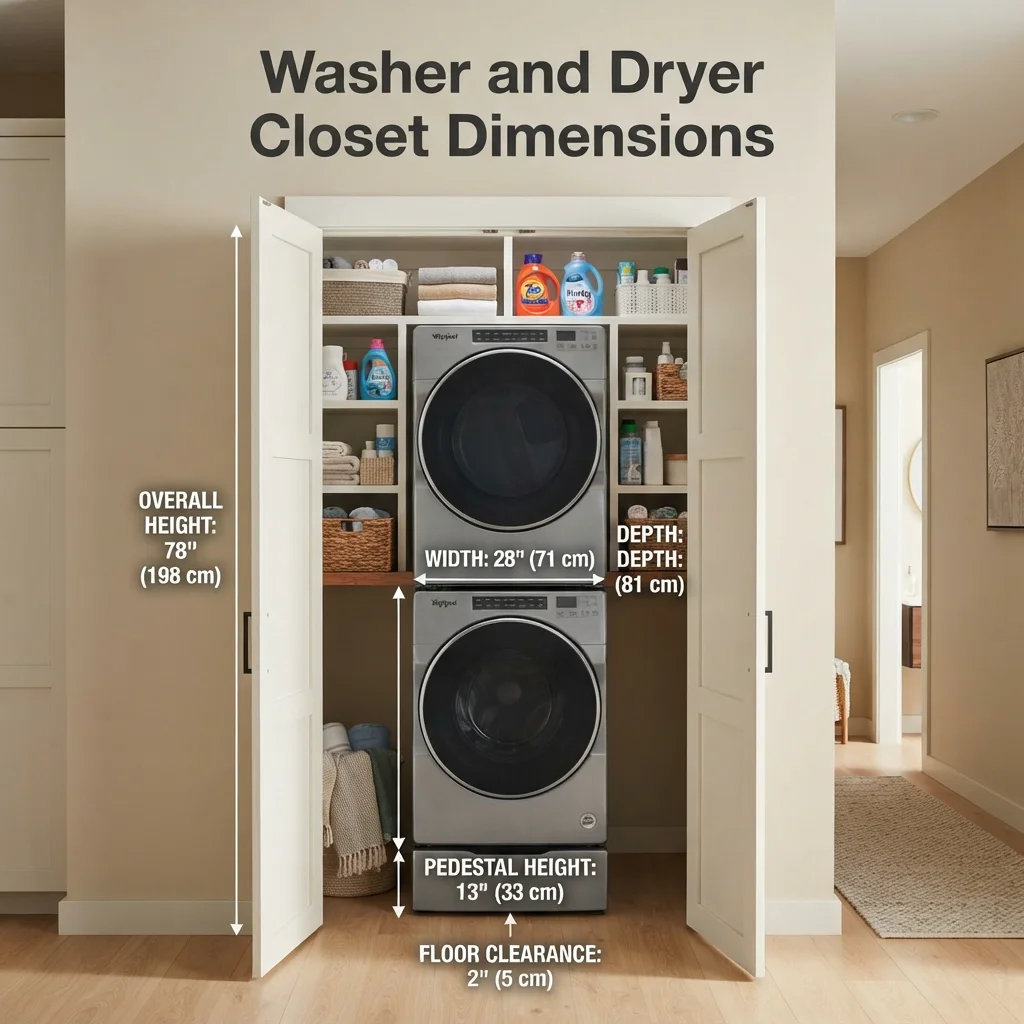
A laundry closet can accommodate a side-by-side pair or a stacked set, depending on its width, depth, height, and door arrangement.
The following examples provide starting points for residential space planning.
| Laundry Layout | Approximate Width | Approximate Depth | Approximate Height |
|---|---|---|---|
| Full-size side-by-side | 60 inches | 36–40 inches | 84 inches |
| Compact side-by-side | 52 inches | 30–34 inches | 80 inches |
| Full-size stacked | 30 inches | 36–40 inches | 84 inches |
| Compact stacked | 27 inches | 30–34 inches | 80 inches |
These are illustrative planning dimensions, not guaranteed minimum requirements. Your actual space requirements depend on the chosen appliances and their installation instructions.
Important Laundry Closet Considerations
Closet opening: Measure the opening separately from the interior dimensions. An appliance may fit inside the closet but fail to pass through the doorway.
Door arrangement: Sliding or bifold doors can help preserve usable floor space. Ensure that the doors do not interfere with loading laundry or accessing appliance controls.
Water and drainage: Allow room for supply hoses, drain hoses, and accessible connections.
Dryer ventilation: A vented dryer needs a suitable exhaust route. Check the duct requirements and permitted installation arrangement.
Electrical and gas connections: Confirm that the required connections are available and correctly positioned.
Overhead storage: Cabinets and shelves should not interfere with a top-load washer lid or the installation of a stacked laundry pair.
How to Measure for a Washer and Dryer
Measuring your laundry area before ordering appliances can help prevent costly delivery and installation problems. Use a tape measure and record the available width, depth, and height.
Step 1: Measure the Available Width
Measure horizontally from one side of the installation area to the other. If you plan to install two machines side by side, add their individual widths and include any required gaps.
For example, two appliances measuring 27 inches wide each need 54 inches of combined appliance width. A wider installation area may be necessary for connections and clearance.
Step 2: Measure the Available Depth
Measure from the back wall to the front edge of the space. Check whether hoses, power cords, water connections, and dryer ducts will project behind the machines.
Also, consider how far the washer or dryer door extends when opened. The listed appliance depth may not represent the total installed depth.
Step 3: Measure the Available Height
Measure from the floor to the lowest obstruction above the installation area. Check for shelves, cabinets, countertops, pipes, and ceiling features.
For stacked appliances, calculate the combined height of the washer, dryer, and approved stacking hardware. For top-load washers, check the open-lid height.
Step 4: Measure Doorways and Delivery Routes
Measure the width and height of the laundry room entrance, hallways, stairways, and any tight turns along the delivery route.
Check the dimensions of the packaging if the delivery company requires the appliance to remain boxed during transport. Also, ask whether doors or other removable components may need to be taken off for delivery.
Step 5: Check the Manufacturer’s Specifications
Before purchasing, review the appliance specification sheet and installation guide. Confirm the exact exterior dimensions, required clearances, utility connections, and any stacking restrictions.
If the available space is tight, compare the total installed dimensions rather than relying only on the product listing’s width, height, and depth.
Common Mistakes When Measuring for Laundry Appliances

Even careful buyers can overlook small details that affect installation. Avoid these common mistakes when selecting a washer and dryer.
Measuring Only the Appliance Width
Two machines may fit within the available width on paper, but surrounding walls, side gaps, and connections can affect the final layout. Measure the full installation area before ordering.
Ignoring Hose and Vent Space
Water hoses and dryer ducts can increase the depth required behind an appliance. Check the connection arrangement and use the manufacturer’s installation dimensions.
Forgetting Door Clearance
A front-load washer needs room for its door to swing open. A top-load washer needs vertical space for its lid. Consider how you will use the appliances after installation.
Choosing a Stacked Pair Without Checking Compatibility
Not every washer and dryer can be stacked safely. Confirm that the manufacturer approves the combination and specifies the correct stacking kit.
Overlooking Delivery Access
The appliance must reach the laundry area without getting stuck in a doorway or hallway. Measure the complete delivery route before finalizing your purchase.
Assuming All Standard Appliances Have Identical Dimensions
A width of 27 inches is common, but height and depth can vary substantially. Always check the specifications for the exact model you intend to buy.
Frequently Asked Questions
How wide is a standard washer and dryer?
Many standard residential washers and dryers are approximately 27 inches wide. Some models are wider or narrower, so consult the manufacturer’s product specifications for exact measurements.
How deep is a standard washer and dryer?
Many full-size residential machines are around 30–34 inches deep. Larger models may be deeper, and hoses, vent ducts, and other connections can increase the total installed depth.
How much space do I need for a washer and dryer side by side?
Two 27-inch-wide appliances require 54 inches of combined width. A space around 60 inches wide is a useful starting point, but the final requirements depend on installation clearances and the selected models.
Can a washer and dryer fit in a 5-foot-wide closet?
A 5-foot-wide closet measures 60 inches across, which may accommodate two 27-inch-wide appliances side by side. However, you must also consider the opening, connection space, required gaps, and door operation.
Are stackable washers and dryers the same size?
No. Compact and full-size stackable appliances can differ in width, height, depth, and capacity. Confirm that both machines are approved for stacking and use the specified hardware.
How tall is a stacked washer and dryer?
A stacked washer and dryer pair is commonly around 66–80 inches tall, depending on the models and stacking kit. Allow additional overhead clearance if required by the manufacturer.
Do washer and dryer dimensions include hoses?
Not necessarily. Published dimensions usually describe the appliance itself, while hoses, vent connections, and other installation components may require additional space. Check the product’s installation guide.
What is the standard size of a compact washer and dryer?
Many compact laundry appliances are approximately 24 inches wide, with heights around 33–35 inches. Their depth and capacity vary by model, so check the manufacturer’s specifications before purchasing.
Can I install a washer and dryer under a countertop?
Some front-load washers and compatible dryers can be installed beneath a countertop if the manufacturer permits the arrangement and sufficient clearance is available. Top-load washers usually require additional vertical space for their lids.
Which is better for a small laundry room: stacked or side-by-side appliances?
Stacked appliances generally save floor space because they use vertical height instead of requiring two appliance widths. Side-by-side machines provide easier access to both appliances at once but need more horizontal space.
Conclusion
Understanding washer and dryer dimensions makes it easier to choose appliances that fit your home and work comfortably in your laundry area. Most full-size residential machines are approximately 27 inches wide, while compact models are often around 24 inches wide. Stacked configurations reduce the required floor width but need sufficient vertical clearance.
Before making a purchase, measure the available width, depth, and height. Remember to account for hoses, electrical or gas connections, dryer ventilation, door movement, and the delivery route.
Most importantly, confirm the exact dimensions and installation requirements for your chosen models. Careful planning can help you avoid fitting problems and create a laundry space that is practical, accessible, and comfortable to use.

Mr. Abdullah is a content writer at Mezvoro who creates helpful, engaging and easy-to-read content for online readers. His work focuses on sharing fresh ideas, useful guides and creative inspiration across a range of topics.