
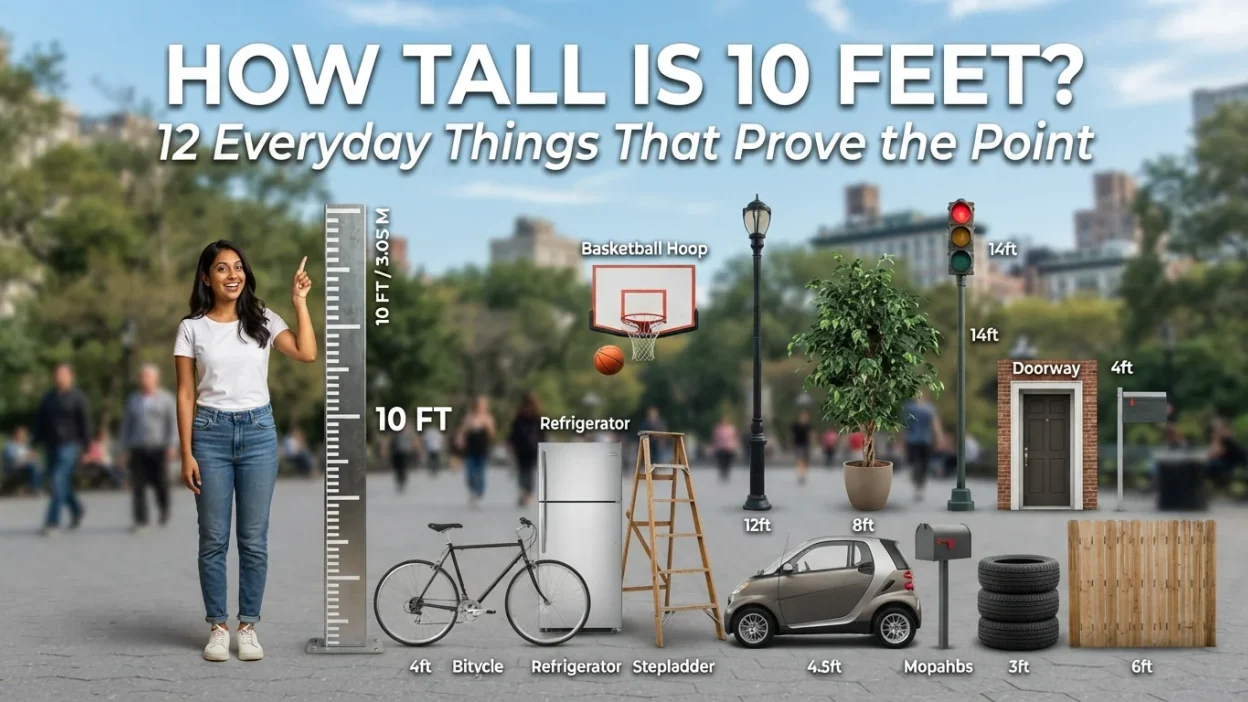
Picture a basketball hoop. Now imagine standing directly underneath it, looking straight up. That rim sits exactly 10 feet above the ground—and for most people, it feels impossibly high. That’s the strange thing about 10 feet. We see it referenced constantly, from hoops to ceilings to ladders, yet few of us can actually picture it in our heads.
Part of the problem is that we live in a world scaled to inches and centimeters. Ten feet is just long enough to feel abstract. It’s taller than a person but shorter than a giraffe. It’s the height of a room, the length of a small car, and the distance a child can sprint in about a second. Your brain has no single anchor for it.
This measurement shows up everywhere in real life. Ceilings, garage doors, fence panels, kayaks, pool cues, and, of course, that basketball rim. Knowing what 10 feet actually looks like helps when you’re buying a ladder, planning a room, or trying to figure out whether something will fit in a space.
10 feet equals 120 inches, 304.8 centimeters, 3,048 millimeters, and 3.048 meters. It’s roughly the height of a basketball rim, about twice the height of an average American man, and just shy of the length of a compact car.
Every Unit 10 Feet Converts To

Ten feet is a tidy number in imperial units, which makes the conversions easy to remember once you see them laid out.
| Unit | Value |
|---|---|
| Inches | 120 |
| Feet | 10 |
| Yards | 3.333 |
| Centimeters | 304.8 |
| Millimeters | 3,048 |
| Meters | 3.048 |
The math is refreshingly simple. There are 12 inches in a foot, so 10 feet is 120 inches. There are 3 feet in a yard, so 10 feet is 3⅓ yards. For metric, one foot equals 30.48 centimeters, so 10 feet is 304.8 centimeters or 3.048 meters.
What makes 10 feet useful is that it’s a round number in both systems of thinking. It’s exactly 120 inches, exactly 3,048 millimeters, and almost exactly 3 meters. That last figure is why so many international building standards land near 3 meters for ceiling heights—it’s the metric equivalent of a very familiar imperial measurement.
If you’re converting the other way, meters to feet, multiply by 3.281. So a 3-meter ceiling is about 9.84 feet—just under 10 feet. This is why European apartments often feel slightly lower-ceilinged than American ones, even though the numbers are nearly identical.
Where 10 Feet Sits on the Size Chart
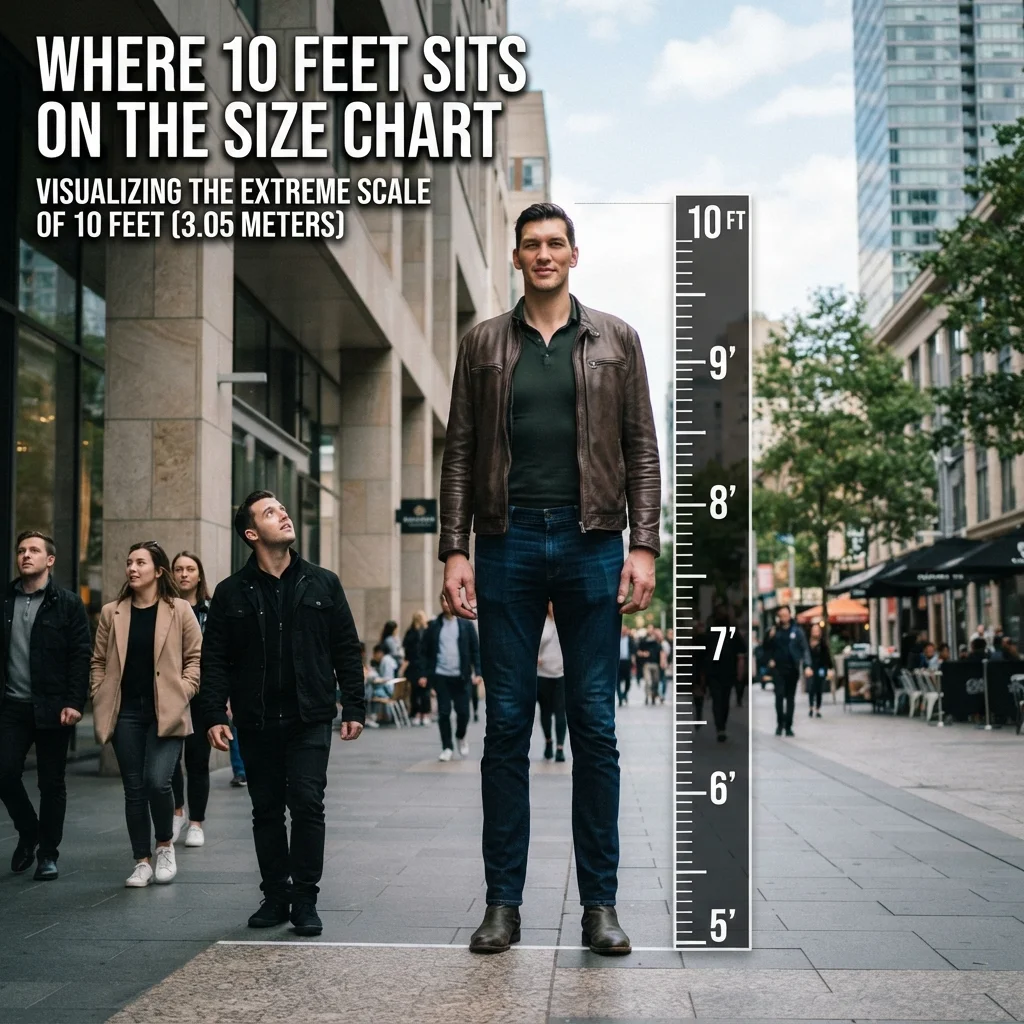
Ten feet is a Goldilocks measurement. It’s tall enough to clear a person’s head with room to spare, but short enough to fit inside a typical residential room. That middle ground is exactly why it appears so often in building codes and sports.
For human height, 10 feet is enormous. The tallest person in recorded history, Robert Wadlow, stood 8 feet 11.1 inches—just under 9 feet. Even he would have to look up at a 10-foot ceiling by more than a foot. The average American man stands about 5 feet 9 inches, which means 10 feet is roughly 1.7 times his height.
In architecture, 10 feet is the classic residential ceiling height in many older American homes. Modern construction often drops to 8 or 9 feet to save on materials and energy, while luxury homes push toward 12 feet or higher. A 10-foot ceiling feels generous without being cavernous.
In sports, 10 feet is legendary. A basketball rim sits at exactly 10 feet, a standard that has held since 1891 when James Naismith nailed a peach basket to a balcony railing. That height wasn’t scientifically chosen—it was simply where the railing happened to be. More than a century later, every professional game in the world still uses that accidental measurement.
For vehicles, 10 feet is a small car. A Mini Cooper is about 12 feet long, while a smart car is closer to 8.8 feet. So 10 feet lands right in the middle of the compact car range.
12 Things That Measure About 10 Feet
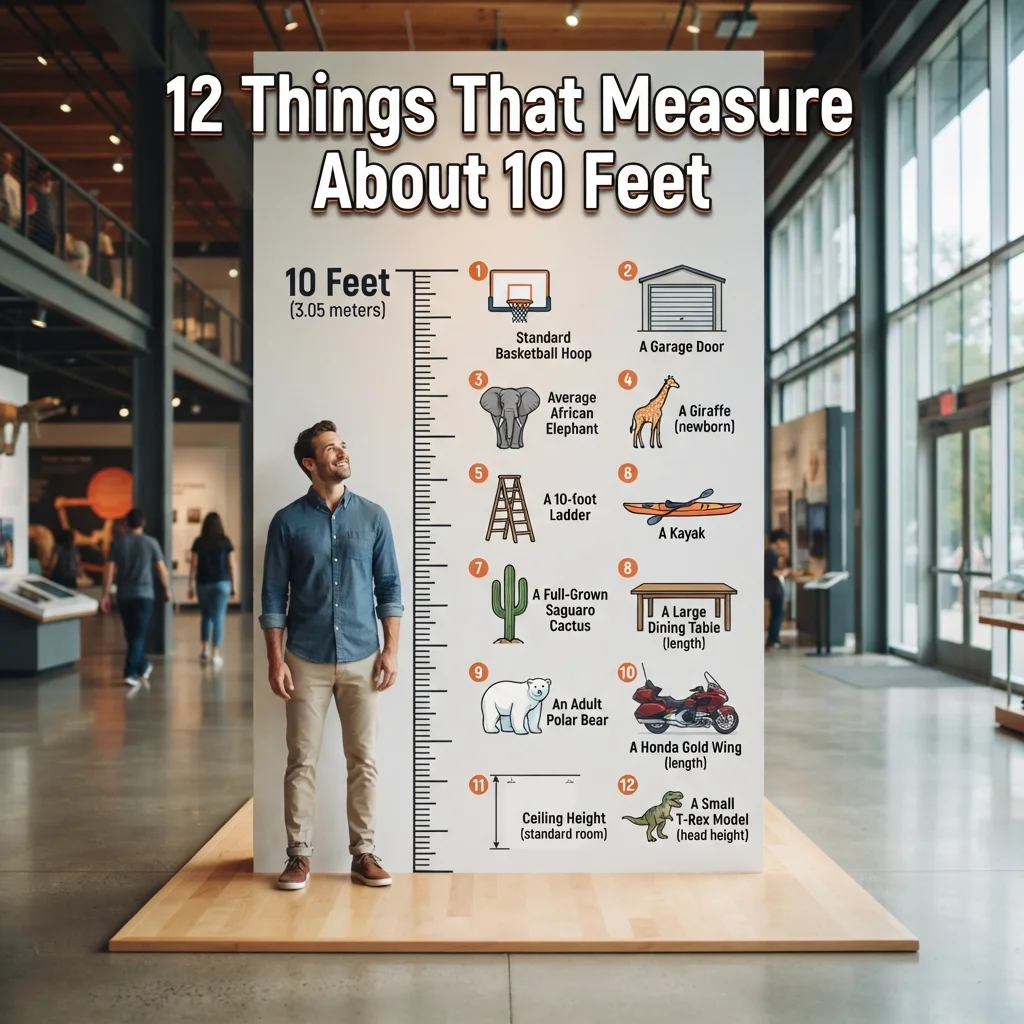
A Basketball Hoop
A regulation basketball rim sits at exactly 10 feet above the floor. That’s not approximate—it’s the official standard used in the NBA, NCAA, and international play.
The height traces back to 1891, when James Naismith improvised the first game using a peach basket nailed to a balcony railing. The railing happened to be 10 feet up, and the number stuck. By the time anyone thought to reconsider, generations of players had trained at that height.
Ten feet is a demanding target. A player who can touch the rim needs a vertical leap of roughly 2 to 3 feet, depending on their standing reach. Dunking requires even more. This is why rim height has stayed constant—lowering it would fundamentally change the sport.
If you want to visualize 10 feet, look at a basketball hoop. Stand under it and imagine stacking two average adult men on top of each other. You’d still be a few inches short of the rim.
A Standard Residential Ceiling
Many homes built before the 1980s have ceilings that sit right around 10 feet. Older Victorian and craftsman houses often pushed even higher.
The shift toward lower ceilings came with modern construction efficiency. Eight-foot ceilings became standard in the mid-20th century because they used less material and were cheaper to heat. But 10-foot ceilings never disappeared—they remain common in living rooms, entryways, and higher-end homes.
A 10-foot ceiling changes how a room feels. It creates vertical space that makes even small rooms seem larger. It also creates practical problems: changing a light bulb requires a ladder, and painting the walls takes considerably more effort than in an 8-foot room.
To picture it, imagine a door. Standard doors are 6 feet 8 inches tall. A 10-foot ceiling is more than 3 feet taller than the top of a door frame.
A Garage Door
Standard single-car garage doors measure 8 feet wide and 7 feet tall. But two-car garage doors often run 16 feet wide and 7 to 8 feet tall. So where does 10 feet fit?
Ten feet is the typical width of a single-car garage door in many newer homes, and it’s also a common height for commercial garage doors. Some residential doors are built 10 feet tall to accommodate trucks, boats, or RVs.
The measurement matters because garage doors are one of the few household features where height is genuinely functional. A 7-foot door won’t fit a lifted truck. A 10-foot door will.
If you’ve ever backed a car into a garage, you know how the door height frames your entire field of vision. A 10-foot opening feels generous—almost like driving into a tunnel.
A Kayak
Recreational kayaks typically run 10 feet long, making this one of the most accessible real-world comparisons for the measurement.
A 10-foot kayak is considered a versatile length. It’s short enough to maneuver easily in tight rivers and creeks, but long enough to track reasonably well on open water. Beginners often start with 10-foot models because they’re forgiving and easy to transport.
Tour kayaks stretch to 14 or 16 feet for better speed and tracking. Whitewater kayaks shrink to 6 or 8 feet for maximum agility. The 10-foot range is the sweet spot for casual paddlers who want a bit of everything.
Lay a 10-foot kayak next to a car and the comparison becomes obvious. It’s roughly the length of a compact sedan, just narrower and pointier.
A Pool Cue Laid End to End

A standard pool cue measures 58 inches—just under 5 feet. Two cues laid end to end would reach 116 inches, or 9 feet 8 inches. Add a few inches and you’re at 10 feet.
This comparison works because pool cues are familiar objects with a known length. Most people have held one or at least seen one up close. Two of them, tip to bumper, give you a nearly exact 10-foot reference.
The math is worth checking. 58 inches times two equals 116 inches. Ten feet equals 120 inches. That leaves a 4-inch gap—about the length of your hand. So two pool cues plus a hand span gets you to 10 feet almost precisely.
Three Standard Doors Stacked Vertically
A standard interior door stands 6 feet 8 inches tall. Stack two of them vertically and you reach 13 feet 4 inches—too tall. But stack one and a half doors, and you land at exactly 10 feet.
This is a useful mental trick because doors are everywhere. If you can picture a door frame, you can picture 10 feet by imagining one and a half of them stacked.
The comparison also highlights how tall 10 feet really is. Most people walk through doors every day without thinking about their height. Realizing that 10 feet is a door and a half puts the measurement into perspective.
A Compact Car
Small cars cluster right around the 10-foot mark. A Honda Fit measures about 13 feet long, a Mini Cooper about 12 feet, and a smart car about 8.8 feet. A classic Mini from the 1960s was just over 10 feet.
The original Mini Cooper, introduced in 1959, measured 10 feet 0.25 inches long. That’s the kind of precision that makes 10 feet feel almost designed rather than incidental.
Modern compact cars have grown, but the 10-foot range still exists in city cars and subcompacts. If you’ve ever squeezed a small car into a tight parking spot, you’ve experienced roughly 10 feet of vehicle.
A Standard Fence Panel
Wooden privacy fence panels commonly measure 6 feet wide and 6 feet tall. But some panels, especially those used for commercial or agricultural fencing, run 10 feet wide.
A 10-foot fence panel is heavy and awkward to handle alone. It requires at least two people to lift and position, and it often needs a third to hold it steady while it’s secured. This practical difficulty is a good reminder of how substantial 10 feet actually is.
If you’ve ever walked along a fence line, you’ve probably passed 10-foot sections without noticing. They’re common enough to blend into the background.
A Giraffe’s Neck Plus Head
An adult giraffe’s neck alone can measure 6 feet long. Add the head, which is roughly 2 feet from base to nose, and you’re at 8 feet. Stretch the neck fully upward and the total reach from shoulder to nose can approach 10 feet.
This comparison is approximate and varies by individual, but it captures the scale. A giraffe browsing high branches is extending roughly 10 feet of body from its shoulders upward.
Giraffes use this reach to access food other animals can’t touch. That evolutionary advantage is built on a measurement that happens to match a very human number.
A Standard Ladder
Extension ladders are sold in sizes that correspond to their maximum reach, not their physical length. A ladder labeled “10 feet” typically measures about 10 feet when fully extended.
Step ladders follow a different naming convention. A 10-foot step ladder is actually about 10 feet tall when opened, though the standing platform sits lower for safety.
Ladders are one of the few household items where the measurement is printed right on the side. If you own a 10-foot ladder, you have a permanent 10-foot reference in your garage.
A Bowling Lane Section
A full bowling lane measures 60 feet from foul line to head pin. Divide that by six and you get 10 feet—the distance from the foul line to roughly the arrows on the lane.
Those arrows, called targeting arrows, sit 15 feet past the foul line. So 10 feet lands between the foul line and the arrows, in the early part of the approach.
Bowlers use this distance to calibrate their throw. A 10-foot segment of a bowling lane is a familiar sight to anyone who has ever played, even if they never thought about the measurement.
A Stack of 10 Standard Bricks
A standard brick measures about 2.25 inches tall. Stack 10 of them and you get 22.5 inches. That’s not 10 feet—it’s not even 2 feet.
This comparison is here to make a point: not every object stacks neatly into 10 feet. Bricks are small. To reach 10 feet, you’d need about 53 standard bricks stacked vertically.
The exercise is useful because it shows how quickly small objects add up. A single brick seems insignificant. Fifty-three of them reach the height of a basketball rim.
The Ceiling Height Question People Actually Mean
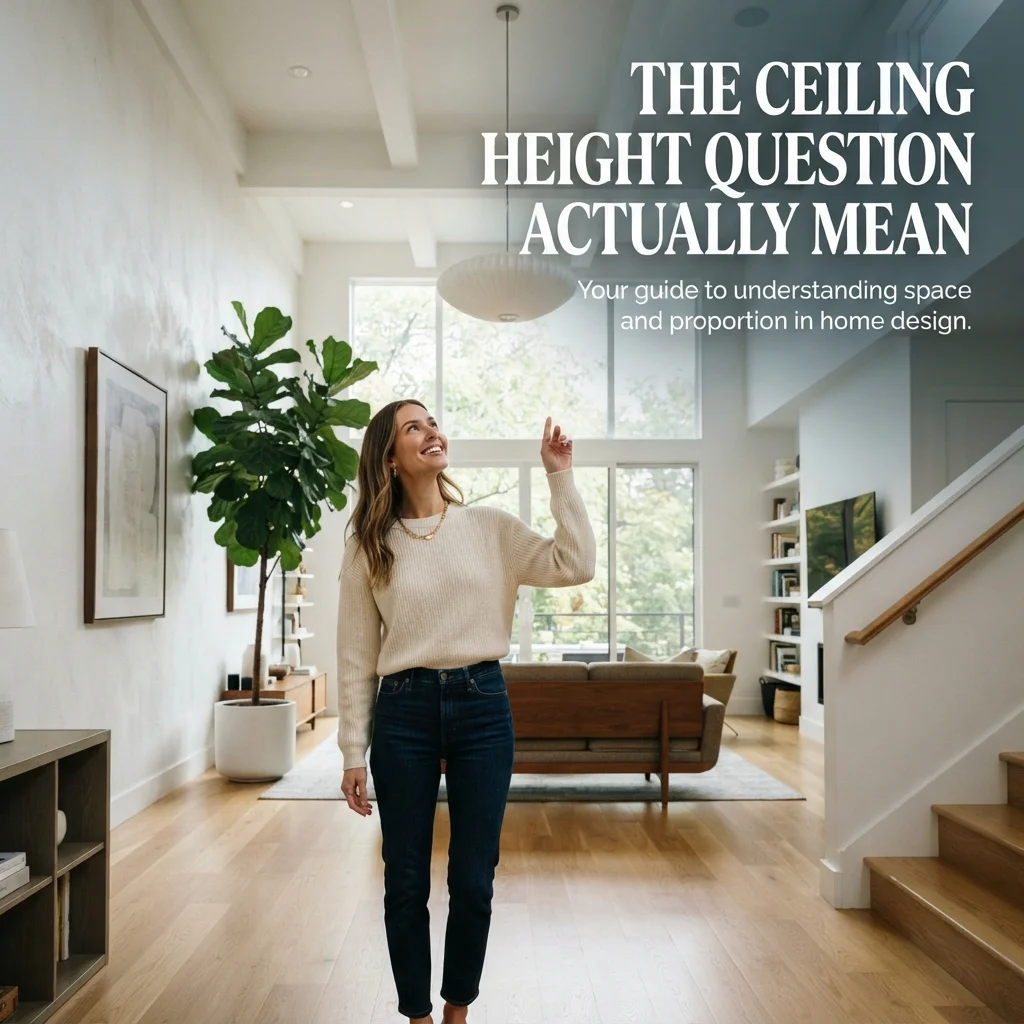
When people search for “how tall is 10 feet,” they’re often trying to answer a specific question: is a 10-foot ceiling tall or normal?
The answer depends on where you live and when your home was built. In the United States, 8-foot ceilings became standard after World War II. Before that, 9 and 10-foot ceilings were common in homes built during the Victorian and craftsman eras. Today, 10-foot ceilings are considered a premium feature in new construction.
In commercial buildings, 10 feet is often the minimum. Offices, retail spaces, and restaurants typically have ceilings between 10 and 14 feet to create a sense of openness and accommodate lighting and ductwork.
In Europe, ceiling heights tend to run slightly lower because building standards evolved around metric measurements. A 2.7-meter ceiling is about 8.9 feet—noticeably lower than 10 feet.
So if you’re standing in a room with a 10-foot ceiling, you’re in a space that’s taller than average for a home but shorter than average for a commercial building. It’s a comfortable middle ground that feels spacious without being wasteful.
Getting to 10 Feet Without a Tape Measure
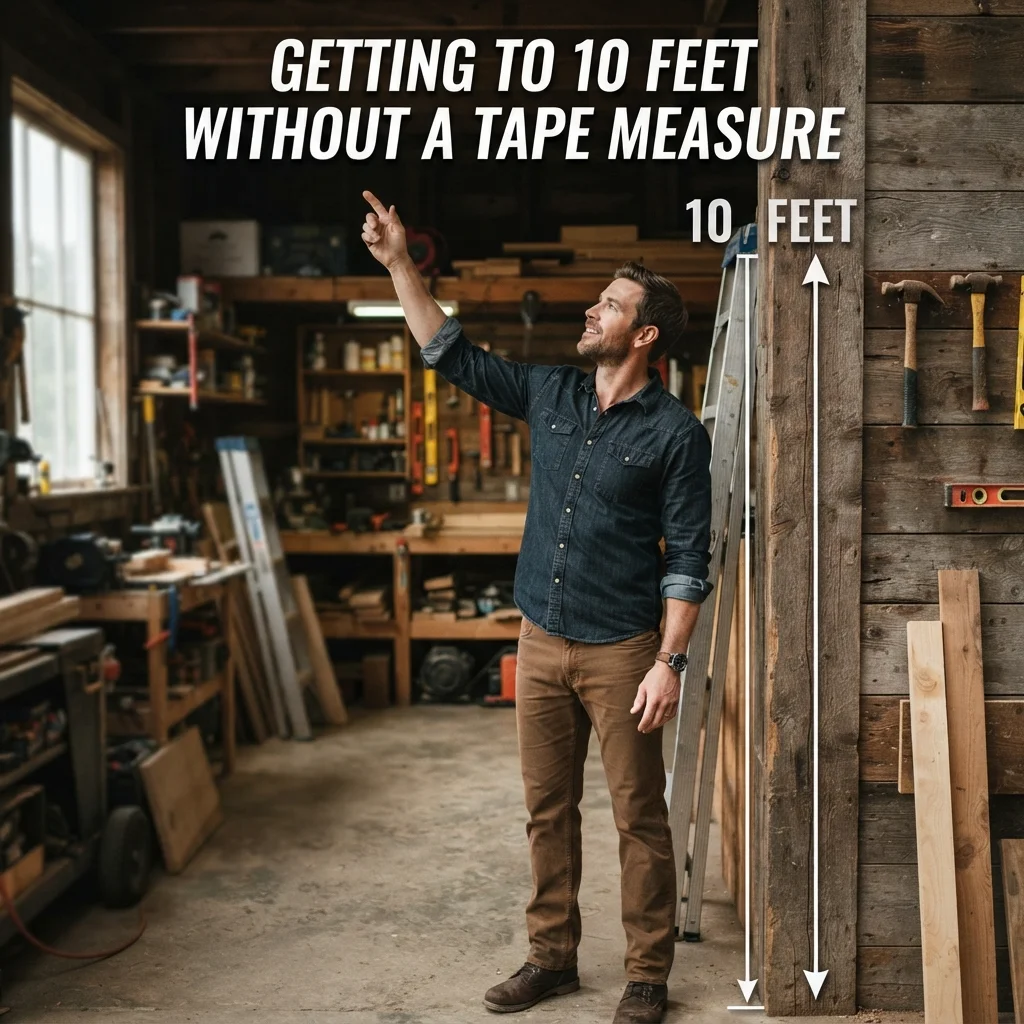
You don’t need a tape measure to estimate 10 feet. Your body and your surroundings provide reliable reference points.
Your height times two, minus a bit. If you’re 5 feet 6 inches tall, two of you stacked would reach 11 feet. Subtract a few inches and you’re close to 10. If you’re 5 feet tall, exactly two of you equals 10 feet.
A standard door plus a half. A standard interior door is 6 feet 8 inches. Add half that height—3 feet 4 inches—and you reach exactly 10 feet. Picture a door with another door cut in half on top of it.
Five average steps. The average adult stride is about 2 feet long. Five steps cover roughly 10 feet. This works best on flat ground with a natural walking pace.
A pool cue doubled. A standard pool cue is 58 inches. Two of them laid end to end measure 116 inches, just 4 inches short of 10 feet. Add a hand span and you’re there.
A basketball hoop. If you have access to a basketball court, you have a permanent 10-foot reference. The rim is exactly 10 feet. Stand under it and look up.
These methods give approximations, not exact measurements. The difference between 9 feet 8 inches and 10 feet might not matter when you’re estimating whether a ladder will reach, but it matters if you’re cutting lumber or ordering materials. Use body-based estimates for quick decisions and a tape measure for anything precise.
[INTERNAL LINK: related measurement article]
FAQs
How many inches is 10 feet?
Ten feet equals exactly 120 inches. This is because there are 12 inches in a foot, and 10 multiplied by 12 equals 120.
How many centimeters is 10 feet?
Ten feet equals 304.8 centimeters. One foot is 30.48 centimeters, so 10 feet is 304.8 centimeters.
How many meters is 10 feet?
Ten feet equals 3.048 meters. This is just over 3 meters, which is why 10 feet and 3 meters are often used interchangeably in casual conversation.
Is 10 feet tall for a ceiling?
Yes, 10 feet is taller than average for a residential ceiling. Standard modern ceilings are 8 to 9 feet. A 10-foot ceiling is considered a premium feature in most homes.
What everyday object is exactly 10 feet?
A basketball rim is exactly 10 feet above the floor. This is the most precise everyday reference for the measurement.
How many people tall is 10 feet?
If you use the average American man at 5 feet 9 inches, 10 feet is about 1.7 times his height. Two average men stacked would reach about 11 feet 6 inches, slightly taller than 10 feet.
Can I visualize 10 feet without a tape measure?
Yes. Picture one and a half standard doors stacked vertically, or two pool cues laid end to end, or five average adult steps. Each gives you a close approximation.
Where That Leaves You
Ten feet equals 120 inches, 304.8 centimeters, or 3.048 meters. It’s the height of a basketball rim, the length of a kayak, and just taller than one and a half standard doors stacked on top of each other.
The strongest reference is the basketball hoop. It’s exact, universal, and instantly recognizable. If you can picture a rim, you can picture 10 feet. Everything else—the ceiling, the garage door, the compact car—is just a variation on that same height.
Next time you stand under a hoop or walk into a room with tall ceilings, you’ll know exactly what you’re looking at. Ten feet isn’t abstract anymore. It’s the space above your head, the length of a small boat, and the target every basketball player has aimed for since 1891.

Mr. Abdullah is a content writer at Mezvoro who creates helpful, engaging and easy-to-read content for online readers. His work focuses on sharing fresh ideas, useful guides and creative inspiration across a range of topics.