
Thirty centimeters is one of those measurements that sounds simple until you try to picture it. It’s a round number in the metric system, which makes it feel familiar to anyone who uses centimeters daily—but for people raised on inches, feet, and yards, 30 cm can be surprisingly hard to visualize.
The confusion makes sense. Centimeters belong to a decimal system where everything divides neatly by ten, while inches follow a completely different logic. There’s no whole-number relationship between the two, so the conversion always lands on a decimal that’s easy to forget. And 30 cm shows up everywhere—ruler markings, product listings, clothing sizes, furniture specs, and package dimensions—so getting it wrong can mean ordering the wrong item or misjudging whether something will fit.
By the end of this guide, you’ll know exactly how long 30 cm is in inches and feet, where it sits among common measurements, and a handful of everyday objects that make the number click.
30 centimeters equals 11.81 inches, or just under one foot.
That’s the number to remember. Now let’s look at where it comes from and how to picture it.
Every Unit 30 Centimeters Converts To
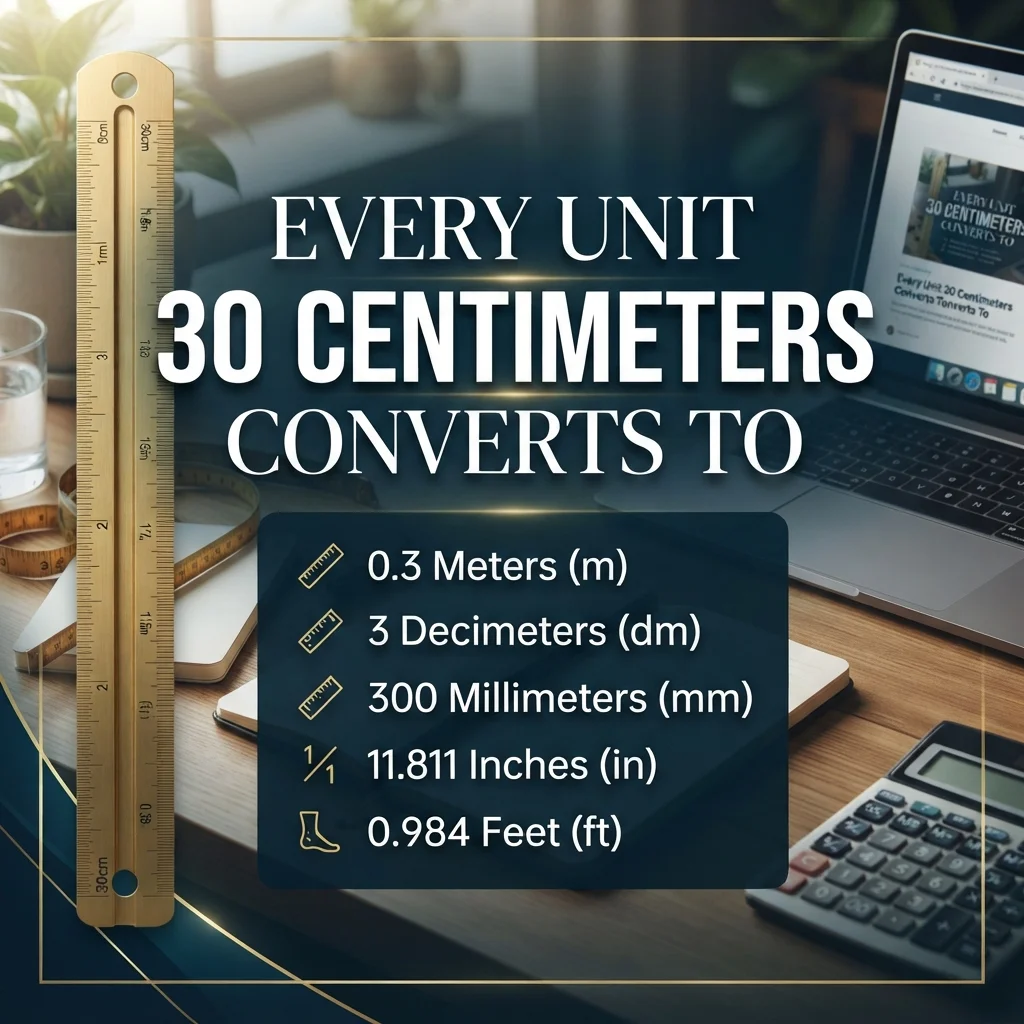
Before comparing 30 cm to everyday objects, here’s the full breakdown across the units people actually search for.
UnitValueCentimeters30Millimeters300Meters0.3Inches11.81Feet0.984Yards0.328
The math is refreshingly simple because centimeters are metric. To get millimeters, multiply by 10—so 30 cm becomes 300 mm. To get meters, divide by 100, which gives you 0.3 meters. Those two conversions require nothing more than moving a decimal point.
Inches are where it gets messier. One inch equals exactly 2.54 centimeters, so to convert 30 cm to inches you divide 30 by 2.54. That gives you 11.811 inches, which rounds to 11.81 inches. For feet, divide the inch figure by 12, landing at roughly 0.984 feet—just a fraction of an inch short of a full foot. And for yards, divide by 36, which comes out to about 0.328 yards.
The key takeaway is that 30 cm is almost 12 inches. The gap is only about 0.19 inches, or roughly 5 millimeters. That’s less than the thickness of a standard pencil. So if you’re in a hurry and need a rough estimate, treating 30 cm as “basically a foot” will get you close enough for most casual purposes.
Where 30 cm Sits on the Measurement Scale
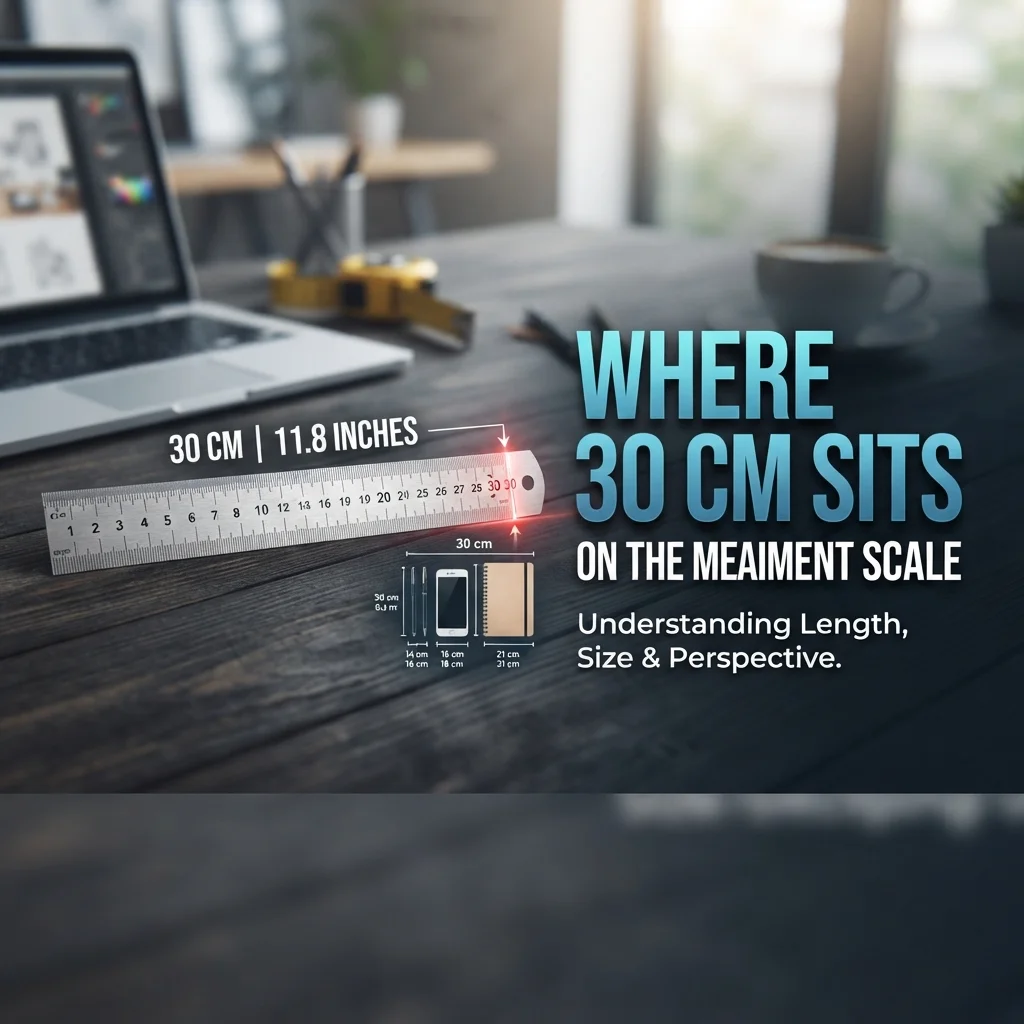
Thirty centimeters falls into an awkward middle zone. It’s too long to be a small handheld measurement and too short to be a major unit like a meter. In practical terms, it’s the length of a short ruler, a large tablet, or a standard sheet of paper measured along its longer side.
Compare it to a few reference points. A standard sheet of A4 paper is 29.7 cm long—so 30 cm is just 3 millimeters longer. A US Letter sheet is 27.9 cm long, meaning 30 cm overshoots it by about 2 cm. A standard 12-inch ruler is 30.48 cm, so 30 cm is slightly shorter than a foot-long ruler.
In the metric world, 30 cm is exactly three decimeters, though decimeters are rarely used in everyday life. It’s also 0.3 meters, which is the kind of measurement you’d see on a furniture listing for the depth of a shelf or the height of a small stool.
The measurement sits in a sweet spot for product dimensions. It’s large enough to be a meaningful length but small enough to fit on a desk or hold in two hands. That’s why so many consumer goods cluster around it—tablets, keyboards, cutting boards, and laptop screens all gravitate toward this range.
11 Things That Measure Around 30 Centimeters
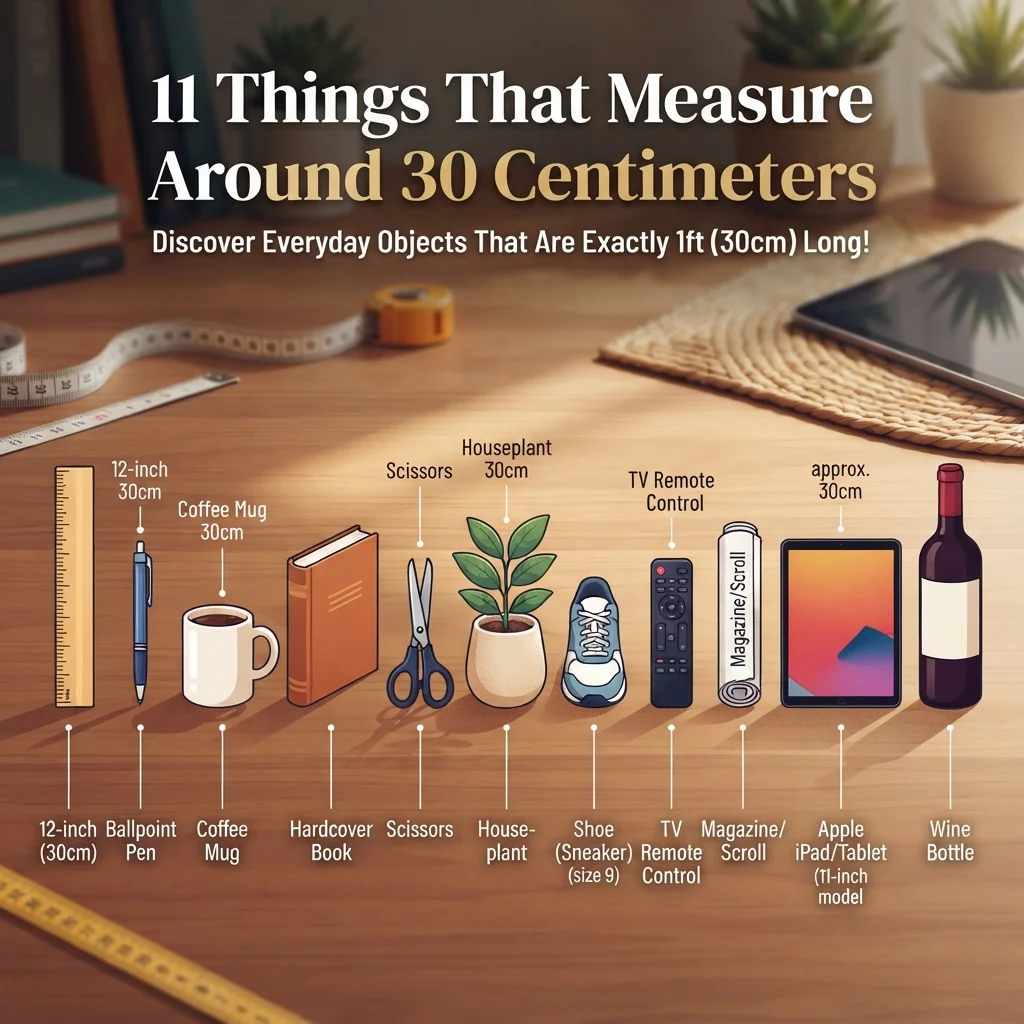
Here are eleven objects that land close to 30 cm, ranging from nearly exact matches to useful approximations.
A Standard A4 Sheet of Paper (Long Side)
An A4 sheet measures 29.7 cm on its long edge, making it the closest everyday match to 30 cm you’re likely to find. The difference is just 3 millimeters—about the thickness of two credit cards stacked together.
A4 is the default paper size across most of the world, used for printers, notebooks, and documents in Europe, Asia, and beyond. If you have any A4 paper nearby, its long side is your 30 cm reference. Lay it flat and you’re looking at 29.7 cm, which is close enough that most people would never notice the gap.
[IMAGE: an A4 sheet of paper lying flat next to a ruler showing 30 cm marked]
A 12-Inch Ruler
A standard foot-long ruler measures 30.48 cm, which is just over half a centimeter longer than 30 cm. The difference is smaller than the width of a typical pencil eraser.
This is one of the most useful comparisons because rulers are designed to be handled and compared. If you have a 12-inch ruler, you have a near-perfect 30 cm reference. The extra 0.48 cm is barely visible at a glance—you’d need to look closely at the markings to spot it.
[IMAGE: a 12-inch ruler next to a metric ruler showing the 30 cm mark to compare lengths]
A Large Tablet Screen
Many large tablets measure around 28 to 30 cm diagonally. A 12.9-inch iPad Pro, for example, has a diagonal screen measurement of 32.8 cm, which overshoots slightly. A 11-inch iPad Air measures 27.9 cm diagonally, falling just short.
The tablet that lands closest is often a 12-inch model, which typically measures around 30.5 cm diagonally. Since screen sizes are measured corner to corner, this gives you a visual reference that’s easy to picture if you own or have seen a large tablet.
[IMAGE: a large tablet held in landscape orientation with a ruler showing its diagonal measurement]
A Standard Keyboard
A full-size desktop keyboard usually measures 43 to 45 cm wide, which overshoots 30 cm by a wide margin. But a compact tenkeyless keyboard—one without the numeric pad—typically runs 35 to 36 cm. Still too long.
The closest match is a 60% mechanical keyboard, which usually measures 28 to 30 cm across. These compact boards strip away the number pad, arrow keys, and function row, leaving just the main typing area. If you use one, its width is almost exactly 30 cm.
[IMAGE: a compact 60% mechanical keyboard next to a ruler showing its width]
A Standard Cutting Board
Small cutting boards come in many sizes, but a common “small” board measures about 30 cm by 20 cm. That makes the long edge a near-perfect 30 cm match.
Cutting board sizes vary enormously, so this comparison depends on which board you have. A large board might be 45 cm or more, while a small prep board could be just 20 cm. The 30 cm size is a middle ground—big enough to chop vegetables but small enough to store easily.
[IMAGE: a small cutting board with a ruler along its long edge showing 30 cm]
A Loaf of Bread
A standard loaf of sliced bread measures about 25 to 30 cm long, depending on the brand and style. A typical sandwich loaf from the grocery store often lands right around 28 to 30 cm.
This is a rough comparison because bread shapes vary so much. A rustic sourdough boule is round and won’t work at all. A Pullman loaf, with its flat top and rectangular shape, is the closest to a consistent 30 cm. Next time you have a loaf on the counter, lay a ruler beside it and see where it lands.
[IMAGE: a loaf of sliced bread on a cutting board with a ruler alongside it]
A Men’s Size 10 Shoe
A men’s US size 10 shoe measures about 27.9 cm from heel to toe, which falls roughly 2 cm short of 30 cm. A size 11 shoe measures around 28.9 cm, and a size 12 reaches 30.2 cm—just over the mark.
So a men’s size 12 shoe is the closest match, at 30.2 cm. That’s only 2 millimeters over 30 cm, which is remarkably precise. If you or someone in your household wears a size 12, you have a built-in 30 cm measuring tool.
[IMAGE: a men’s size 12 shoe with a ruler placed alongside it showing the length]
A Standard Laptop Screen (13-Inch Class)
A 13-inch laptop screen measures about 33 cm diagonally, which overshoots 30 cm. A 12-inch laptop screen measures around 30.5 cm diagonally—very close to the target.
Screen sizes are measured diagonally, corner to corner, and manufacturers round to the nearest inch. So a “12-inch” laptop might actually measure anywhere from 29 to 31 cm diagonally. That range makes it a useful but imprecise comparison. The 30 cm mark sits comfortably within the 12-inch laptop category.
[IMAGE: a 12-inch laptop with a tape measure showing the diagonal screen measurement]
A Standard Sheet of Toilet Paper
A single square of toilet paper measures about 10 cm by 10 cm in most standard rolls. Three squares laid end to end give you 30 cm. That’s a surprisingly accurate way to estimate the length if you’re ever caught without a ruler.
The width of a toilet paper roll is typically 10 to 11 cm, so three widths side by side also gets you to roughly 30 cm. It’s not a glamorous reference, but it’s one of the most universally available objects in any home.
[IMAGE: three squares of toilet paper laid end to end next to a ruler showing 30 cm]
A Standard Dinner Plate
A typical dinner plate measures 25 to 28 cm in diameter. A large dinner plate or a charger plate can reach 30 to 33 cm. So a standard plate falls short, while a large one overshoots slightly.
The closest match is a 12-inch plate, which measures 30.5 cm across. If you have a set of larger dinner plates, measure one across the middle—there’s a good chance it lands within a centimeter of 30.
[IMAGE: a large dinner plate with a ruler across its diameter showing 30 cm]
A Standard Yoga Block
A yoga block typically measures 23 cm long, 15 cm wide, and 10 cm tall. None of those dimensions reach 30 cm. Two blocks placed end to end give you 46 cm, which overshoots significantly.
This one doesn’t work as a 30 cm reference. It’s included here to show that not every household object fits the target. If you’re looking for a 30 cm comparison, skip the yoga block and reach for the A4 paper or the ruler instead.
[IMAGE: a yoga block next to a ruler showing its shorter dimensions]
The Ruler Question People Actually Mean

When people search for “30 cm to inches,” they’re often standing in front of a ruler or a measuring tape, trying to figure out whether 30 cm will fit a space, match a product listing, or satisfy a requirement. The real question isn’t always about conversion math—it’s about whether 30 cm is “big enough” or “small enough” for whatever they’re doing.
The most common hidden question is whether 30 cm is the same as 12 inches. The answer is no, but it’s close. Twelve inches equals 30.48 cm, so 30 cm is 0.48 cm shorter—about a fifth of an inch. If you’re measuring something that needs to be at least 12 inches, 30 cm won’t quite make it. If you need at least 30 cm, a 12-inch ruler gives you a small cushion.
Another frequent question is whether 30 cm is a standard size for anything specific. It’s not a universal standard the way 8.5 by 11 inches is for paper, but it does appear as a common dimension in product listings, especially for items sold internationally.
The third question people often have is how to read 30 cm on a tape measure that only shows inches. Since 30 cm is 11.81 inches, you’d look for the mark just before the 12-inch line. On a tape measure with fractional markings, that’s roughly 11 and 13/16 inches. It’s close enough to 12 inches that most people would round up in casual conversation, but for precise work you’d want to use the exact figure.
Getting to 30 cm Without a Ruler
If you don’t have a ruler or measuring tape nearby, here are a few ways to estimate 30 cm using things you already have.
Use a standard sheet of paper. An A4 sheet is 29.7 cm on its long side—so close to 30 cm that the difference is negligible for most purposes. Fold it in half and you get 14.85 cm, which is useful if you need a smaller reference.
Use a dollar bill. A US dollar bill measures 15.6 cm long. Two bills laid end to end give you 31.2 cm, which overshoots 30 cm by just over a centimeter. Fold one bill in half and you get 7.8 cm, so two folded bills end to end equal 15.6 cm—half of 30 cm. Double that and you’re back to 31.2 cm.
Use your hand span. The average adult hand span—from the tip of the thumb to the tip of the pinky when the hand is stretched wide—is about 20 to 23 cm for men and 18 to 20 cm for women. That’s shorter than 30 cm, so one hand span won’t do it. One and a half hand spans gets you into the right range for many people.
Use a credit card. A standard credit card is 8.56 cm long. Three and a half cards laid end to end equal roughly 30 cm. That’s a bit unwieldy but workable if you’re in a pinch and have a few cards in your wallet.
Use a pen. A standard ballpoint pen is about 14 to 15 cm long. Two pens laid end to end give you 28 to 30 cm—close enough for a rough estimate.
30 cm to Inches FAQs
How many inches is 30 cm?
Thirty centimeters equals 11.81 inches. To convert centimeters to inches, divide the centimeter value by 2.54, since one inch equals exactly 2.54 centimeters. That gives you 30 ÷ 2.54 = 11.811 inches, which rounds to 11.81.
Is 30 cm the same as 12 inches?
No, but it’s close. Twelve inches equals 30.48 centimeters, so 30 cm is 0.48 cm shorter than a foot. The gap is less than half a centimeter, or about one-fifth of an inch. For casual purposes, 30 cm and 12 inches are nearly interchangeable, but for precise work the difference matters.
How many feet is 30 cm?
Thirty centimeters equals approximately 0.984 feet. That’s just under one full foot. To get this figure, first convert 30 cm to inches (11.81), then divide by 12 to get feet. The result is 0.984, meaning 30 cm falls about 0.016 feet short of a foot—roughly 0.19 inches.
How many millimeters is 30 cm?
Thirty centimeters equals 300 millimeters. Since one centimeter equals 10 millimeters, you simply multiply 30 by 10 to get 300. This is one of the easiest metric conversions because it only requires moving the decimal point one place to the right.
How many meters is 30 cm?
Thirty centimeters equals 0.3 meters. To convert centimeters to meters, divide by 100. So 30 ÷ 100 = 0.3. This means 30 cm is just under one-third of a meter.
What everyday object is about 30 cm long?
The closest everyday match is an A4 sheet of paper, which measures 29.7 cm on its long side. A standard 12-inch ruler is 30.48 cm, just slightly longer. Other good references include a small cutting board, a compact 60% keyboard, and a large dinner plate.
Is 30 cm a standard size for anything?
Thirty centimeters appears as a standard dimension in several products. A 30 cm ruler is a common school and office supply in metric countries. A 30 cm necklace chain is a typical choker length. Many small shelves, drawer organizers, and storage boxes are designed with 30 cm as a key dimension because it’s a convenient size for both metric and imperial users.
How do I convert 30 cm to inches without a calculator?
Divide 30 by 2.5 instead of 2.54 for a quick estimate. That gives you 12 inches, which is slightly high but close enough for casual purposes. For a more accurate mental math approach, remember that 30 cm is about 11.8 inches—just under a foot. That’s the number to keep in your head.
Where That Leaves You
Thirty centimeters equals 11.81 inches, or roughly 0.984 feet—just a hair under a full foot. The conversion is simple once you know the multiplier: divide centimeters by 2.54 to get inches, or multiply by 10 to get millimeters and divide by 100 to get meters.
The strongest real-world comparison is an A4 sheet of paper, which measures 29.7 cm on its long edge. The difference is only 3 millimeters, so if you can picture a standard piece of printer paper, you can picture 30 cm. A 12-inch ruler is the other go-to reference, landing just 0.48 cm over the mark.
For a quick mental shortcut, treat 30 cm as “basically a foot.” It’s not exact, but it’s close enough for most everyday situations—whether you’re checking whether something will fit on a shelf, estimating a package size, or settling a friendly debate about metric versus imperial. Keep the 11.81-inch figure in your back pocket for when precision matters, and you’ll never be caught off guard by 30 cm again.